Hook the right problem
Open with a situation the customer already recognizes instead of a generic company introduction.
We focus on strong hooks, useful storytelling, brand consistency and clear next steps so social audiences, product shoppers and local service prospects can move forward with less confusion. The practical goal is more useful attention, stronger trust and better creative testing.
Every recommendation is judged by a practical question: will this make the business easier to understand, easier to choose or easier to run?
Open with a situation the customer already recognizes instead of a generic company introduction.
Let the viewer see what changes after using the product or service.
Choose creator-style, cinematic, educational or service-led formats based on the audience and offer.
Build a repeatable content system rather than depending on one lucky post.
Open with a situation the customer already recognizes instead of a generic company introduction.
Let the viewer see what changes after using the product or service.
Choose creator-style, cinematic, educational or service-led formats based on the audience and offer.
Build a repeatable content system rather than depending on one lucky post.
Good Content Creation should not begin with a list of features. It should begin with the part of the business that is unclear, slow or costing opportunities. We review the current customer journey, the questions that delay decisions and the work your team repeats. That gives the project a practical purpose: more useful attention, stronger trust and better creative testing. Defining the result first also protects the budget. It helps us separate the ideas that move the business forward from additions that only make the project larger. The scope becomes easier to explain, the team knows what success should look like and future improvements can be judged against a real customer or operational need.
The experience has to make sense to social audiences, product shoppers and local service prospects. We organize information in the order people need it, use plain language and make the next action easy to recognize. Decisions around strong hooks, useful storytelling, brand consistency and clear next steps are judged by how well they reduce uncertainty. A visitor should understand what the offer is, who it is for, why it is credible and what happens after they respond. A team member should understand what information is required and who owns the next action. Clarity is not a cosmetic preference. It is what helps a customer feel confident enough to continue and what helps staff deliver a consistent response after the enquiry arrives.
Clients rarely buy a page, workflow or campaign because it contains more features. They buy because they want a better situation. We translate the work into benefits such as faster response, fewer repeated tasks, easier comparison, stronger proof or more useful visibility. Features are selected because they support those benefits. This keeps the work focused and makes the value easier to explain internally. It also avoids a common problem: a project that looks impressive in a presentation but becomes difficult to use. The practical test is whether each part helps create more useful attention, stronger trust and better creative testing without adding unnecessary steps for the customer or team.
A focused first version often creates value sooner and teaches more than a large plan built on assumptions. We identify the highest-value journey, build it carefully and test it against realistic situations. Real use may show that one field is unnecessary, one message is unclear or one approval step belongs somewhere else. Starting with a useful core allows those lessons to shape the next investment. It reduces risk because the business can see progress and confirm the direction before expanding the scope. Small does not mean careless. It means prioritizing the path that matters most and giving that path the attention it needs to work well.
A customer experience can fail between tools even when each tool appears to work. A form may collect an enquiry but send it to the wrong inbox. Content may earn attention but lead to a weak page. A useful page may rank for a search but offer no clear next step. We review these handoffs and connect the pieces that matter. The aim is not to integrate everything. It is to remove gaps that create delay, duplicate work or lost information. This is why Forgeposts combines design, development, automation, content and search under one accountable family-run team instead of treating every channel as a separate project.
Trust grows when claims are supported by relevant evidence. Depending on the service, that may include project examples, customer reviews, process details, demonstrations, screenshots or verified numbers. We place proof near the question it answers instead of collecting every badge in one crowded section. When a scenario is illustrative, we label it clearly rather than presenting it as a client achievement. We do not invent performance statistics or guarantee outcomes that depend on competition, pricing, sales ability or market conditions. Honest proof may feel less dramatic than a fabricated case study, but it attracts better-fit customers and protects the reputation that the business is trying to build.
Digital work keeps changing after launch. Accounts need clear ownership, private keys should remain protected, content needs updates and outside services can change their prices or rules. We explain what the client owns, which third-party services are involved and what maintenance is sensible. The work should be understandable enough that future improvements do not require starting again. A proper handover includes access, documentation and next steps. This matters because the value of Content Creation grows when the business can keep learning, add new proof and improve the customer experience based on real behaviour instead of being trapped by a setup only one provider understands.
We review performance using measures that match the original goal. Depending on the project, that can include response time, completed forms, qualified calls, appointment attendance, time saved, search visibility, content engagement or reduced errors. One number rarely tells the entire story. A page can receive more traffic but fewer useful enquiries, while a smaller audience can produce stronger sales conversations. We combine available data with staff feedback and recurring customer questions. That evidence helps decide whether the next step should be clearer wording, stronger proof, a different offer, a new feature or a simpler process. Measurement should guide improvement, not create reports that nobody uses.
Real project references are described accurately. Illustrative scenarios explain a sensible use case without pretending to be verified client results.
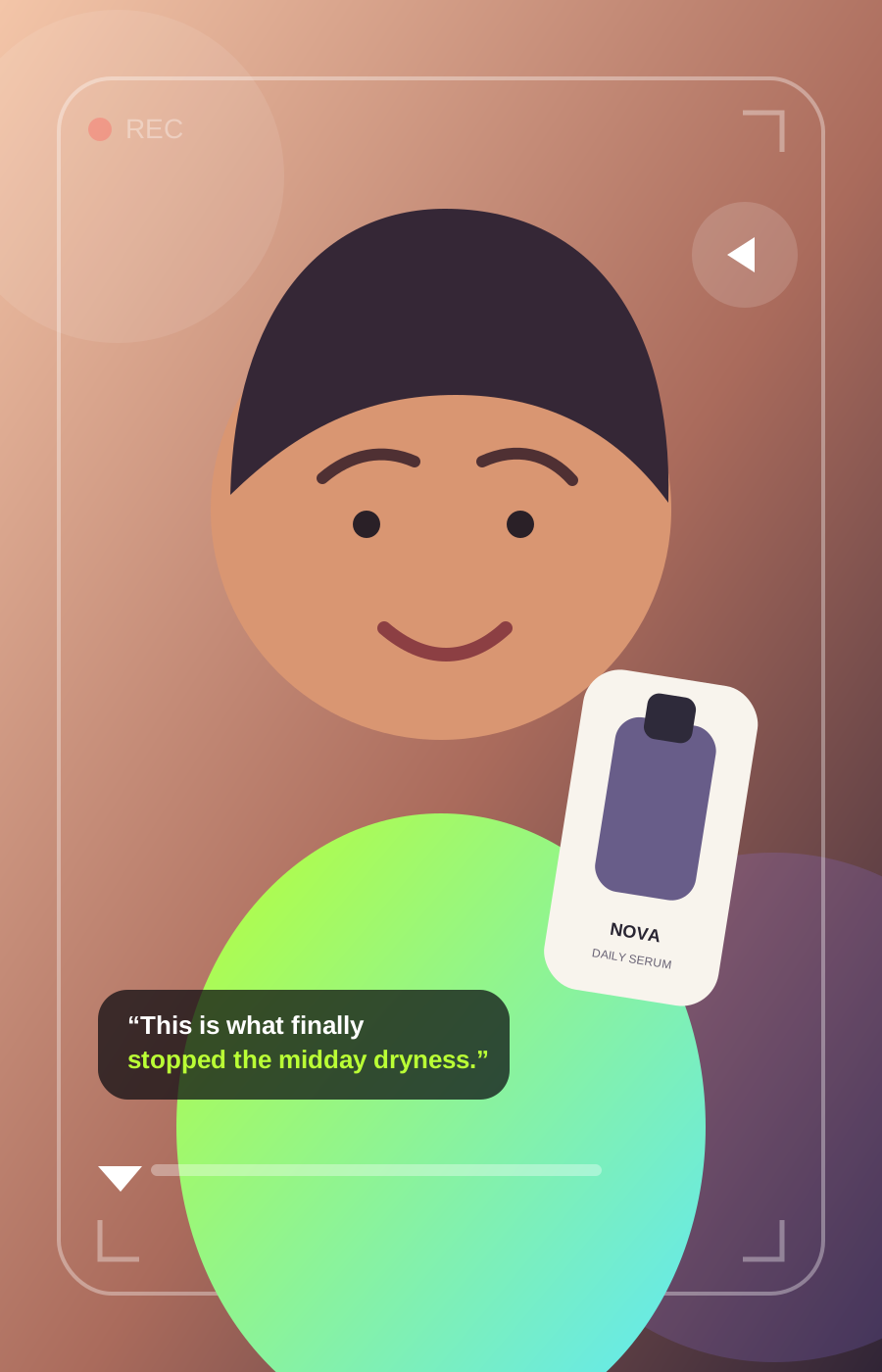
A conversational product discovery concept with natural captions and a believable problem-solution arc.
A premium motion concept built around lighting, texture, detail and desire.
A before-and-after promotion that connects a visual change to a clear customer benefit and offer.
These are target outcomes, not guaranteed statistics. Actual performance depends on the offer, market, sales process and consistent use.
The opening earns a reason to keep watching.
The story shows why the offer matters in real life.
Different hooks and formats can be tested without changing the entire campaign.
Clear answers about scope, timing, ownership and realistic expectations.
Cost depends on the scope, existing materials, writing, design, integrations, review needs and the condition of the current system. We define the desired result and provide a clear scope before work begins.
A focused project may take a few weeks. Larger builds, complex content production and projects with several integrations take longer. The timeline and client responsibilities are agreed before kickoff.
Yes. A focused first version is often the best way to prove value, collect real feedback and reduce risk before expanding the scope.
After the agreed balance is paid, you own the approved custom work, excluding clearly identified third-party tools, subscriptions and licensed assets.
No. We design the work to support measurable improvement, but outcomes also depend on competition, pricing, the offer, sales follow-up and client participation.
Usually. We review whether the existing tools are stable and suitable before deciding whether to connect, improve or replace them.
Start with a short brief. We will use the call to understand the problem, explain the trade-offs and map the most useful first phase.
Get my growth blueprint ↗